How to Find a Leak in a Flat Roof (Without Ripping It Up)
Why flat roof leaks are so hard to trace, which checks to do before paying anyone, and how electronic leak detection pinpoints the breach — from £500.
Here’s the uncomfortable truth about flat roof leaks: the drip in your ceiling is almost never under the hole in your roof. Water gets in at one point, tracks sideways along the deck or insulation — sometimes for metres — and shows up somewhere else entirely.
That’s why “we patched where it was wet” fails, why some roofs get patched three winters running, and why we run electronic leak detection: a non-invasive test that pinpoints the actual breach to under a centimetre, backed by a written report — and, for new roofs, a test certificate.
Why you can’t find a flat roof leak by looking
On a pitched roof, water falls downhill and the entry point is roughly above the damage. On a flat roof, everything conspires against you:
- Water travels. A pinhole at a seam can feed a ceiling stain four metres away, following the path of least resistance along the deck.
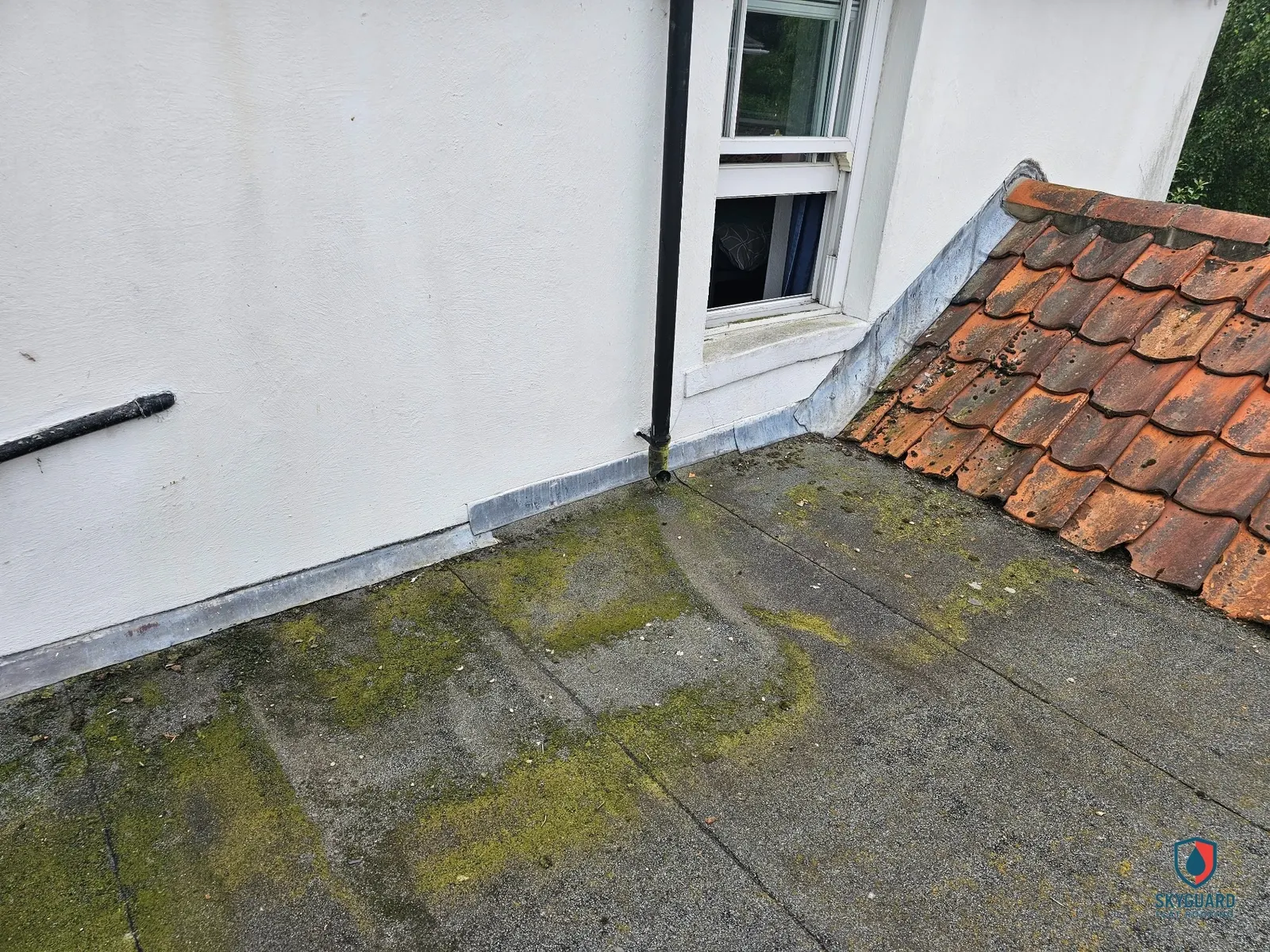
- The evidence lies. Ponding, staining and moss show where water sits — not where it gets in.
- The real hole is often tiny. A screw dropped and trodden in, a split the width of a hair at an upstand. Invisible from a ladder, invisible in photos.
So a visual inspection alone — ours or anyone else’s — is educated guessing. Guessing is how you end up paying for repair number three on the same roof.
Do these free checks before you pay anyone
Yorkshire honesty: not every “leak” needs a £500 test. Ten minutes of checking first:
- Gutters and outlets. A blocked outlet backs water up over the flashing line — the roof is fine, the drainage isn’t. Clear them and watch the next downpour.
- Mastic and flashings. Look where the roof meets walls, skylights and pipes. Cracked mastic or lifted lead lets water in above the membrane.
- Rain check. Does the damp patch appear only after rain? If a ceiling gets damp in cold, dry weather, you may be looking at condensation, not a leak — common on cold-deck roofs, and a warm roof upgrade problem, not a patch-it problem.
- Look upstairs first. Bathroom waste pipes and heating pipework cause a surprising share of “roof leaks”.
Still leaking after that? Now it’s worth finding the breach properly — here are the 7 warning signs it’s more than a one-off.
How electronic leak detection actually works
The physics is simple: your membrane — single ply, EPDM, GRP, modern felt — is an electrical insulator. Water, and the roof deck beneath, conduct. So:
- We lightly wet the roof surface and place a charged electrode around the perimeter. The voltage is low — no risk to the roof, the building, or anything in it.
- A probe scans the roof systematically. Wherever the waterproof layer is breached — even a pinhole — current passes through to the deck and completes the circuit.
- Every breach gets marked on the roof, to the centimetre. Not “somewhere near the outlet”. There.
- Nothing is cut, drilled or stripped. The roof is left exactly as we found it — apart from now knowing where the holes are.
A standard domestic roof takes 1–2 hours on site. One honest caveat: on old built-up bitumen roofs with multiple layers, electronic testing can be inconclusive and we may recommend thermal or smoke testing instead — we’ll tell you that at survey stage, not after billing you.
And yes — we don’t fit GRP, but we’ll happily find the crack in yours.
The report: your evidence, in writing
Within 48 hours of the test you get a full written report:
- A plan drawing of your roof with every breach located and numbered
- Photos of each defect and the surrounding condition
- What caused it, in plain English
- Recommended repairs with prices — typically £250–£500 for small breaches once we know exactly where they are
The report is yours. Use it for an insurance claim — insurers accept it as evidence of the cause and extent of damage — hand it to your landlord or management company, or take it to another contractor for quotes. We’d rather you had proof than promises.
Certificates: proof your roof is watertight
Detection isn’t just for leaking roofs. The same test proves a roof doesn’t leak — and we certify it:
- New installations. An electronic integrity test on completion, with a dated test certificate confirming the membrane tested watertight before handover. Main contractors and architects increasingly require this on commercial projects — and it’s the paperwork that makes a 20-year warranty mean something on day one.
- Planned maintenance. For landlords and facilities managers, periodic testing with certificates builds a dated record that the roof was sound — invaluable for insurance, compliance files, and dilapidations arguments.
- Buying or selling. A test certificate answers a surveyor’s “flat roof — condition unknown” note better than any verbal assurance. Pairs well with a roof survey.
What it costs — and what it saves
£500 flat for the test and the written report, across South Yorkshire — Rotherham, Sheffield, Doncaster, Barnsley and everywhere between. Commercial roofs quoted by size.
What it saves is the expensive part:
- Guess-patching at £250–£300 a visit, three visits, leak still there: £900 and a wet ceiling.
- The nuclear option — stripping a whole roof because nobody could find one 5mm breach: thousands, for a roof that mostly didn’t need replacing.
- The wrong diagnosis — sometimes the test proves the membrane is sound, and the water’s coming from a parapet, a pipe or condensation. That result costs £500 and saves a roof’s worth of unnecessary work. We’ll tell you straight either way.
Most of the time we can fix what we find on the same visit; repair costs are in our repair price guide.
When to book electronic leak detection
Book the test when:
- A ceiling stain keeps coming back after rain, and you’ve done the free checks above
- The roof has already been patched once or twice and still leaks
- You need evidence for an insurance claim
- You’re handing over a new roof and the client wants an integrity certificate
- You manage property and want dated proof the roofs are sound
- You’re buying a house with a flat roof and “condition unknown” isn’t good enough
Flat roof leak FAQs
Will the test damage my roof? No. Low voltage, a lightly dampened surface, no cutting or drilling. The roof is untouched.
How long does it take? 1–2 hours on site for a typical domestic roof; the written report lands within 48 hours. Commercial roofs are quoted per size.
Does it work on my roof type? Single ply, EPDM, GRP and modern felt — yes, reliably. Multi-layer built-up bitumen can need thermal or smoke testing instead; we advise before you spend anything.
Can you fix the leak on the same visit? Usually — we carry common repair materials, and small breaches typically run £250–£500 once located. Bigger repairs get a written quote.
What if the leak isn’t the roof? Then the report says so, with evidence. Knowing your membrane is sound is worth as much as finding a hole — it stops you re-roofing to fix a plumbing problem.
Stop guessing. Find it.
- Book a test — call Chris on 07807 815181, or start with the 60-second estimator and pick “Electronic Leak Detection”
- £500 flat, sub-centimetre accuracy, insurer-grade report in 48 hours — and if it can be fixed on the day, we’ll fix it on the day
Details correct as of August 2026. Full service details on our electronic leak detection page.
Need a flat roof estimate?
60 seconds, no callback chasing. Just an honest price range.
Get my price