Green Roof Benefits in South Yorkshire: Worth It?
The real benefits of a sedum green roof in South Yorkshire — wildlife, drainage, roof lifespan and planning — plus the honest downsides nobody mentions.
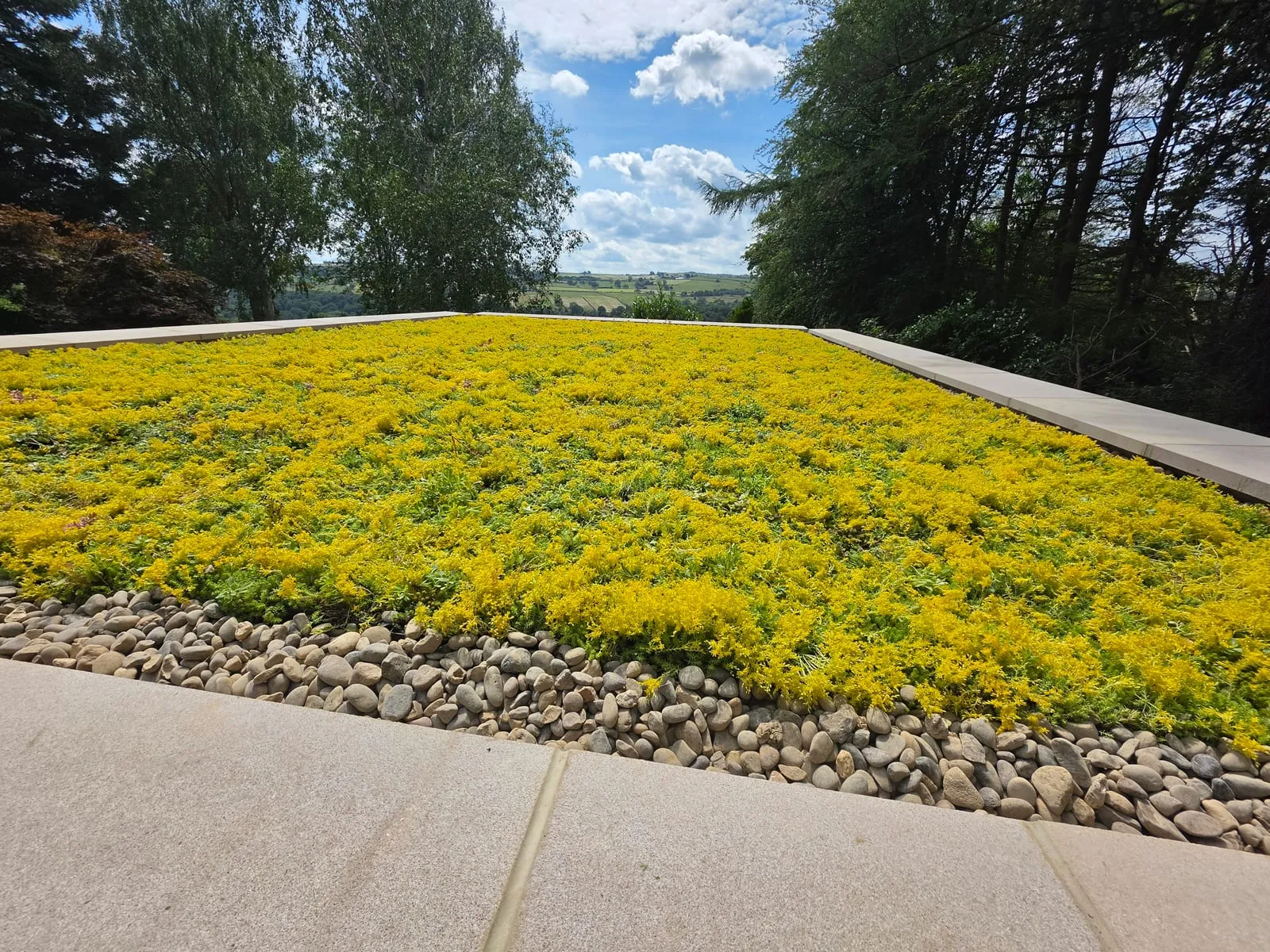
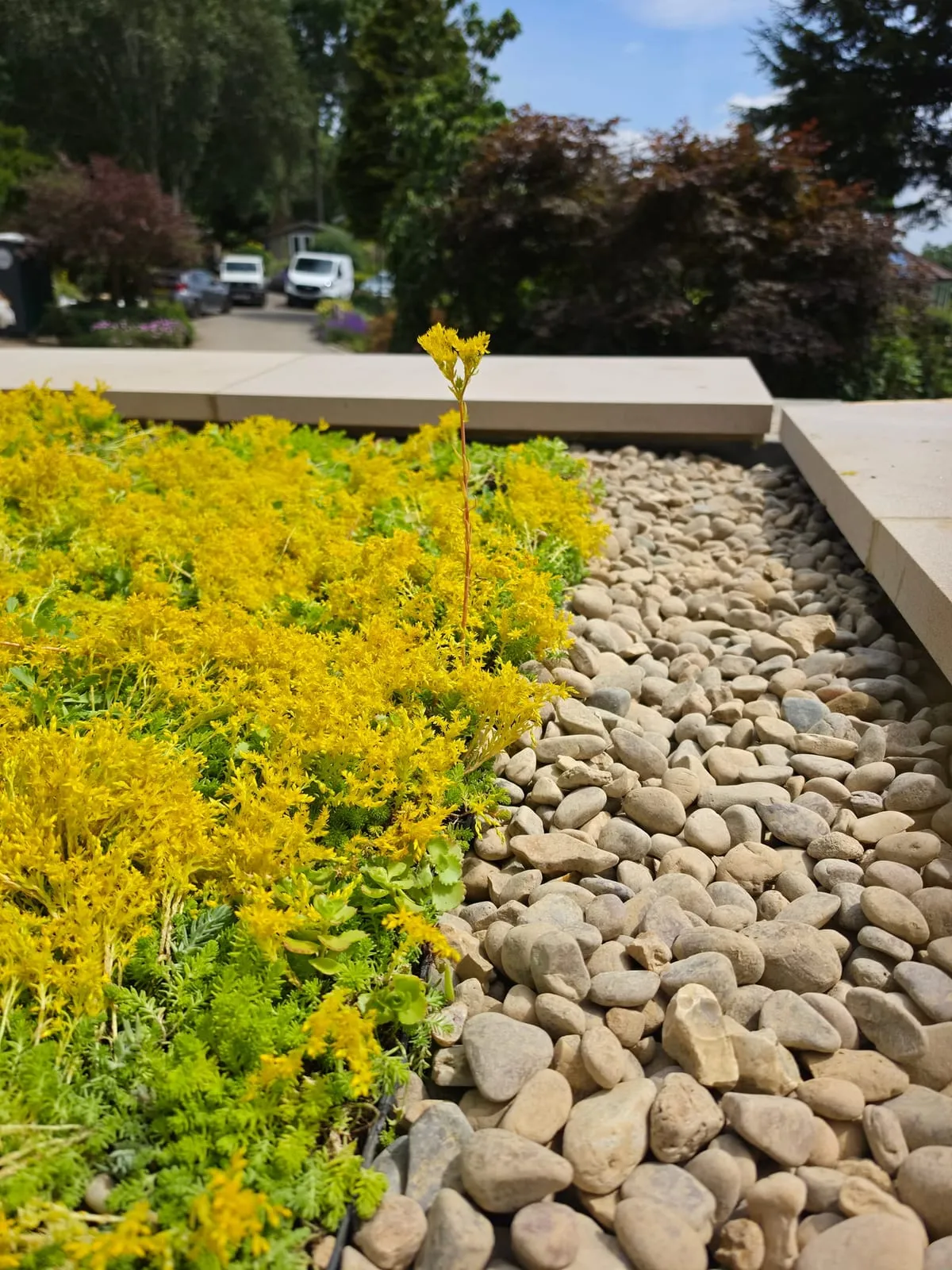
We have just finished our first sedum green roof of the summer — a stone-built garage in the Sheffield area, with a roof the owners look down on every time they glance out of the window. The photos in this post are all from that job, taken the day the sedum went down. Nothing is a stock image, and nothing has been retouched.
If you are weighing up a green roof for a garage, garden room or extension anywhere in South Yorkshire, this guide covers what you actually get for your money, what it costs you in weight and upkeep, and the one thing that decides whether a green roof is a joy or a disaster — because it is not the plants.

What a sedum green roof actually is
A green roof is not turf on top of your garage. A proper build-up, from the bottom:
- A root-resistant single ply membrane. The waterproof layer. Heat-welded seams, no glue, engineered to stop roots as well as rain.
- A drainage layer. Water needs somewhere to go — a saturated roof with nowhere to drain is a pond with plants in it. On the Fatra tray system we use, the tray itself drains the roof and holds a reserve of water for the plants.
- Pebble margins. A border of stones around every outlet, and along the edges wherever the planting does not run up to an upstand, so the drainage stays clear and the sedum stays where it should.
- Pre-grown sedum. Sedum is a family of low, drought-tolerant, succulent plants that need barely any soil. It arrives already established — not seed and hope. Ours are pre-grown Fatra Modular Trays, and the sedum on the Sheffield job was already in flower the day it went down.
That last point matters. “Green from day one” is not a sales line — it is the difference between a living roof and six months of staring at bare matting.
The benefits — in proper detail
1. It feeds the wildlife your garden is missing
A flowering sedum roof is a meadow where a grey rectangle used to be. Through early summer it flowers gold and yellow, and it pulls in bees, butterflies, hoverflies and the rest of the pollinators that have had a rough couple of decades. If you keep a garden anywhere from Rotherham to the Peak fringe, the roof stops being dead space and starts pulling its weight.
This is also the benefit you can see from the kitchen window. On single-storey buildings — garages, garden rooms, extensions — the roof is often the biggest surface you look at. Given the choice between grey membrane and a flowering meadow, most people do not need long to decide.
2. It slows the water down
South Yorkshire knows exactly what heavy rain does. When a downpour hits a hard roof, every drop goes straight into the gutter, into the drain, and into a drainage network doing its best to cope with everyone else’s roof at the same time.
A sedum build-up works like a sponge. It holds a good share of the rain that lands on it, uses some, and releases the rest slowly over hours instead of seconds. One garage roof will not stop a flood on its own — anyone who tells you otherwise is selling something. But it noticeably eases the load on your own gutters and drains, and it is the kind of sustainable drainage some councils now ask for on new builds and extensions.
3. It protects the roof underneath — and that is worth real money
Ask any roofer what actually kills a flat roof and the honest answer is not rain. It is UV and temperature swings. Sunlight slowly degrades exposed roofing materials, and the daily cycle of heating and cooling works every seam and detail, year after year.
A sedum layer takes almost all of that punishment instead of the membrane. The waterproofing underneath sits in the shade at a far steadier temperature, which is why a membrane under a green roof is widely expected to outlast an exposed one. You are not just buying a pretty roof — you are buying a sunshade for the part of the roof that does the actual work.
4. It takes the edge off summer heat
The room under a bare flat roof cooks in July. A living, moist, planted layer absorbs and evaporates heat rather than conducting it straight through the deck — so garden offices and extensions under sedum stay noticeably more comfortable on hot days, and the extra build-up adds a little winter buffering too.
Being straight with you: a green roof is not a substitute for proper insulation. If your roof needs a warm roof upgrade, do that as part of the job — the two work well together, but one does not replace the other.
5. It can help at planning
If you are putting an extension, annexe or garden building through planning, a green roof can count in its favour. Councils are under pressure to deliver biodiversity and sustainable drainage, and a living roof helps on both. It also drops a single-storey building into its surroundings far more gently than a grey rectangle. It is no guarantee of anything, though: every application is decided on its merits, so check with your local planning authority before you commit, and talk to them early if your home is in a conservation area or inside the Peak District National Park boundary.
6. It looks better — and overlooked roofs are everywhere
Most of the flat roofs we fit in Rotherham, Sheffield, Doncaster and Barnsley are overlooked by somebody — the main house, the neighbours, the hill behind. If a roof is part of your view, making it a living one is the single biggest visual upgrade available. The Sheffield garage in these photos went from builder’s-yard grey to flowering meadow in an afternoon.
The honest downsides
If a benefits list has no downsides, it is an advert. Here is what a green roof costs you:
Weight. Fully wet, the Fatra sedum trays we use weigh about 65 kg per square metre, and 75 kg with a wildflower mix — like parking three bags of cement on every square metre of roof. Plenty of structures take that comfortably. Some need strengthening. Some are simply not suitable, and the only honest way to know is a structural engineer’s calculation before the green roof goes on. We install on the basis of their calculation.
Cost. The sedum system sits on top of the cost of the membrane roof beneath it. The 60-second estimator prices both, with an electronic leak test included, and our green roof cost guide works through real sizes. Structure, access and edge details still vary, so ring us on 07807 815181 or book a free quote visit and we will give you a real number in writing.
It is not yellow all year round. Sedum flowers gold in early summer, sits green through the growing season, and blushes red and bronze through drought and winter. It is a living thing with seasons, and anyone whose brochure shows permanent flowering is selling you a photograph, not a roof.
A little maintenance. Once a year, in early autumn after the nesting season: pull any windblown weeds, clear the outlets and pebble margins, and give it an organic feed. No mowing, no watering once established except in a long dry spell. If ladders are not your thing, our maintenance plans cover green roofs as well as single ply.
The bit that actually decides everything: the waterproofing
Here is the uncomfortable truth about green roofs, and the reason we tell people to choose the installer by the membrane, not the plants.
A green roof is a permanently damp, rooted layer sat directly on your waterproofing. If that membrane has a poorly welded seam or a botched detail at an upstand, the leak is invisible under a carpet of sedum — and finding it means stripping the living roof off again. A green roof done badly is not a slightly worse green roof; it is a garden-sized problem bolted on top of a leak.
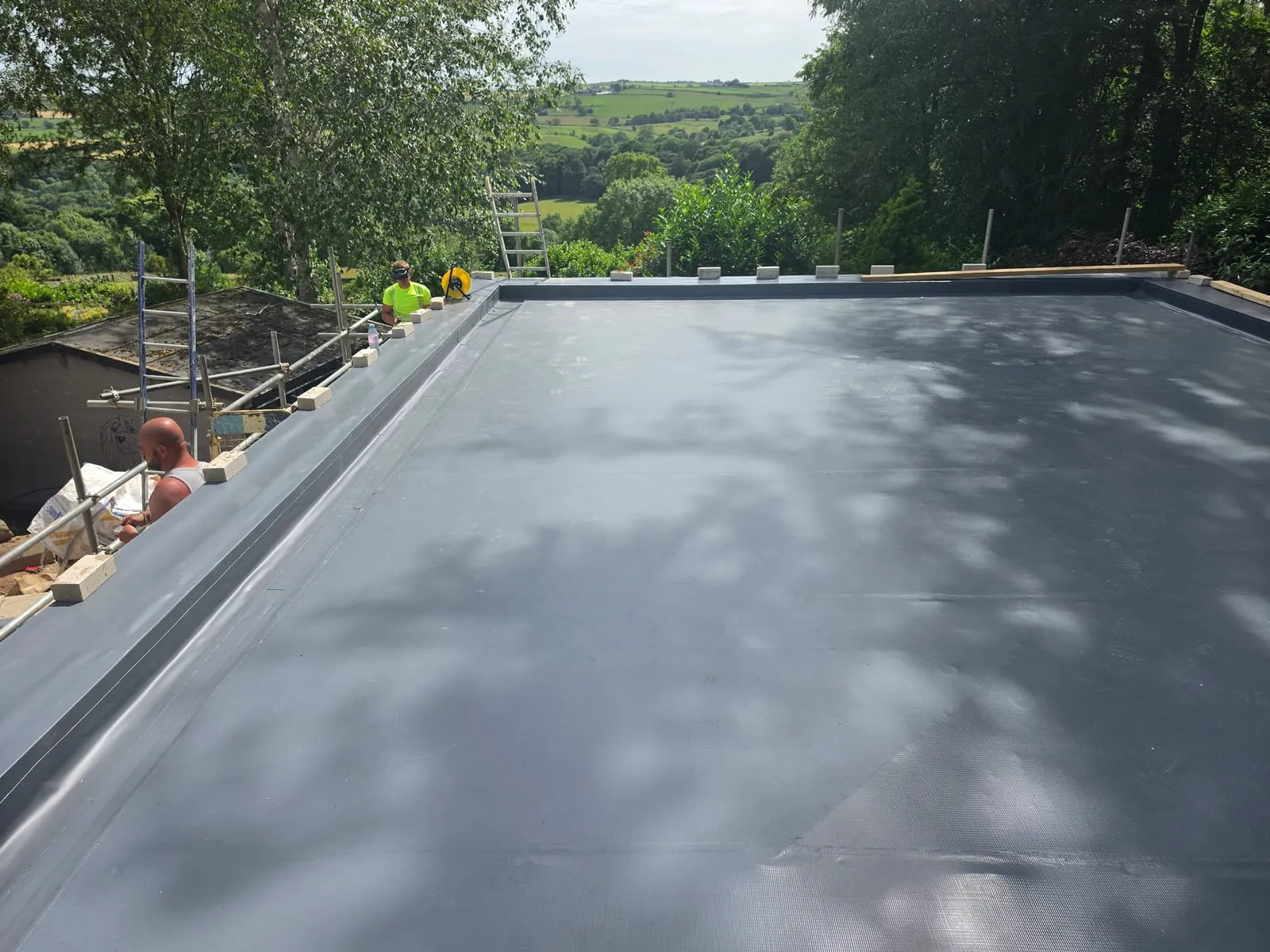
That is why the sequence matters. On the Sheffield job the root-resistant single ply membrane went down first, in June, welded and finished to the same standard as every roof we fit — the same standard that won us an SPRA award for detailing. Then, and only then, the sedum. And because leaks hide under green roofs, on every green roof we lay we run electronic leak detection across the finished membrane before a single plant goes on — a live electrical test that finds faults a visual check cannot.
The membrane carries our standard cover — a 20-year manufacturer-backed warranty plus our 20-year workmanship guarantee, both in writing. The sedum itself is a living layer, so it does not carry a 20-year warranty: Fatra guarantees its sedum trays for 1 year, and we hand the roof over with clear care guidance rather than pretending plants come with a certificate.
Where green roofs work around South Yorkshire
The sweet spot is single-storey buildings you can see the roof of:
- Detached garages and carports — like the Sheffield job in these photos
- Garden rooms, offices and annexes — the roof becomes the view from the house
- House extensions — where the bedroom windows look down on the flat roof, and where planning goodwill is worth the most
- Commercial buildings — bin stores, cycle shelters, walkway canopies and office extensions where a biodiversity line in the planning application can count in its favour
We cover the whole county from our yard in Kilnhurst — Rotherham, Sheffield, Doncaster, Barnsley and everywhere between — and for green roofs we also cover the North East Derbyshire edge: Dronfield, Holmesfield, Eckington and Chesterfield, with no extra charge for travel. Planning one on an extension, garage or garden room? Our guide to green roofs on smaller buildings covers the structure, edges and drainage to get right.
Quick answers
Can you put a green roof on my existing flat roof? Sometimes — the membrane must be root-resistant and in genuinely good condition, and the structure must take the weight. On most tired felt roofs the membrane alone rules it out, so the usual answer is a new membrane with the green roof built on top, done once and done properly. If we keep a membrane we didn’t lay, we test it electronically first, and that test is £500.
How long does it take? The membrane goes down like any single ply roof — usually a day on a home, or two at most with roof lanterns, gutters and other details. The sedum layer itself goes on in hours.
Is it worth it? If your roof is overlooked, your structure can take the weight, and you are already replacing or building the roof anyway: in our view, yes — you get the wildlife, the drainage, the planning goodwill and a longer-lived membrane for one extra line on the quote. If none of those apply, we will tell you to keep your money. We do that a lot.
If you are planning an extension or garden building, or you have a garage roof that deserves better than grey, the green roofs page has the full detail of how we build them. Get a green roof price in sixty seconds, or ring 07807 815181 and ask about a sedum roof. We can give your structural engineer Fatra’s weights to work from.
Need a flat roof estimate?
60 seconds, no callback chasing. Just an honest price range.
Get my price