Solar Panels on a Flat Roof: A Roofer's Guide (2026)
Solar panels on a flat roof? A roofer's guide to checking the roof first, ballasted vs fixed frames, protecting the membrane and keeping your warranty valid.
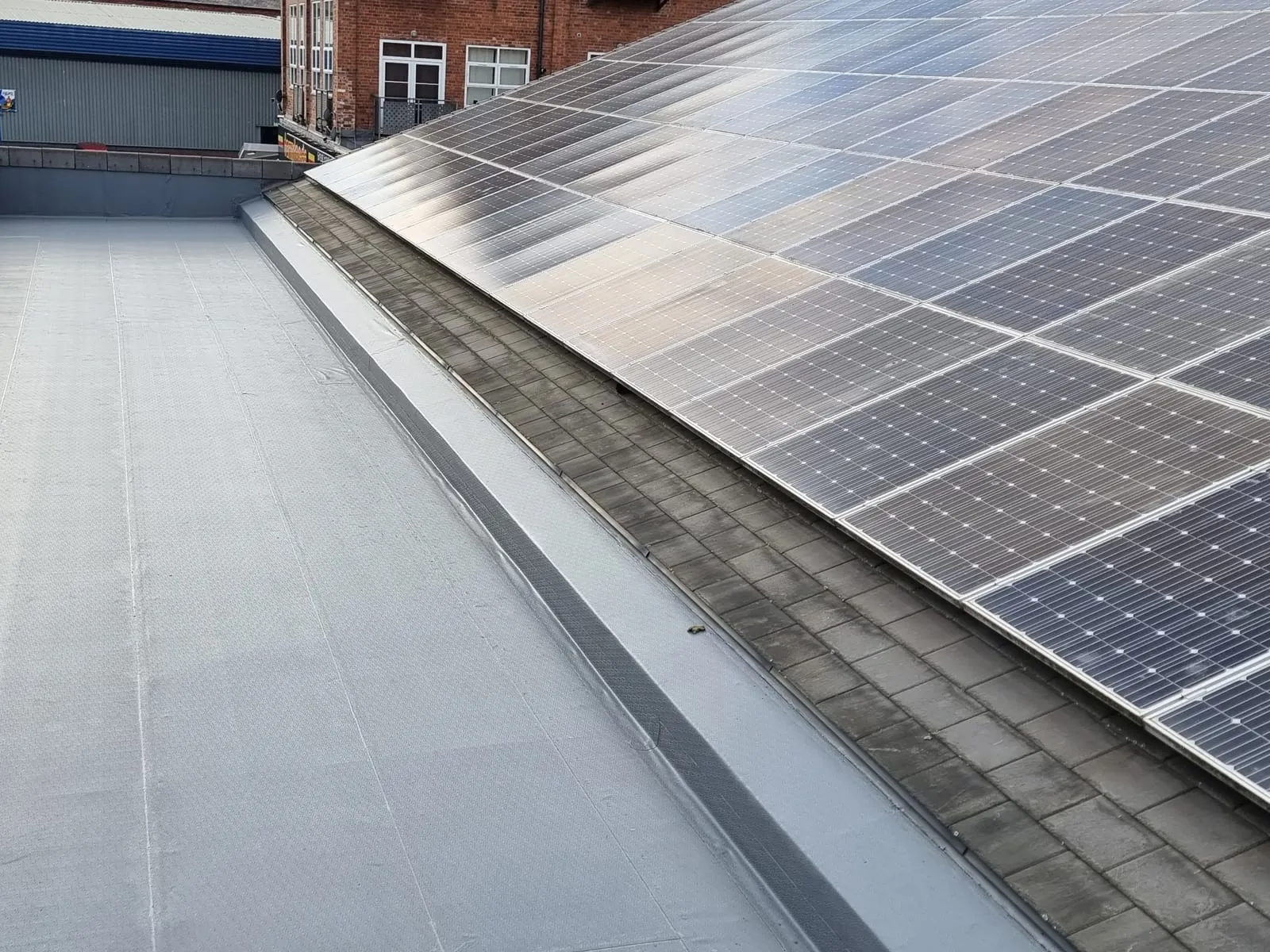
Straight answer first: yes, a flat roof is a good place for solar panels, but get the roof right before they go on. A solar array is designed to stay up for 25 years or more, so the roof underneath has to outlast it, the frames mustn’t damage the waterproofing, and anything fixed to the roof has to be done in a way that keeps your roof warranty valid.
We’re flat roofers, not solar installers, so we don’t fit panels. Our job is the roof under them: replacing it if it won’t last, protecting the membrane where the frames sit, and working alongside your installer. This guide covers what we’d want you to know before anyone carries a panel up the ladder.
Can you put solar panels on a flat roof?
Yes. On a flat roof the panels sit on frames that tilt them towards the sun, either facing south or in back-to-back east–west rows. There are no tiles to lift, the array is often out of sight from the street, and the frames can go where they work best rather than wherever the roof slope happens to face.
The catch is that the roof is now doing two jobs. It keeps the weather out, and it carries the array. Both need checking before installation day.
Step 1: will the roof outlast the panels?
This is the question most people skip. If the roof fails five years after the panels go on, the installer has to take the array off, the roof is replaced, and the array goes back on. You end up paying for the new roof and for the panels to come off and go back on, when you could have paid for the roof alone.
Our rule of thumb: if your flat roof wouldn’t last another 25 years, replace it before the panels go on.
| Your roof now | What we’d advise |
|---|---|
| New single ply roof, or one about to go on | Ready. Tell us about the panels at the quote visit so the roof is planned around them. |
| Single ply in good condition, laid by someone else | A Roof Survey (£250–£600) first, to confirm its condition and how long it has left. |
| Felt | Replace it first. Felt typically lasts 10–20 years in total, less than a solar array is designed to. |
| GRP, EPDM, or any roof that already leaks | Book a free quote visit before the installer does anything. Panels make every later repair harder to reach. |
What a new roof costs before the panels go on
These are homeowner prices, inc VAT, straight from our estimator:
- Single garage, about 20 m²: £2,000–£2,360
- Double garage, about 30 m²: £3,000–£3,540
- Rear extension, about 40 m², to warm-roof spec: £5,600–£6,320
Roofs from first floor up need scaffolding, which adds £1,000–£2,000. The smallest job we take on is £950. If you’re adding solar to cut your bills, it’s worth asking about a warm roof at the same time: insulation adds £40/m², and it’s far easier to add before the panels go on than after. For your own figure, the estimator takes about a minute, and the full breakdown is in how much a flat roof costs.
Step 2: can the roof carry the array? That’s the engineer’s call
Panels, frames and any ballast add weight, and wind tries to lift the whole array off the roof. Whether your roof can take that is a structural question, and it isn’t one a roofer should answer.
The MCS installation standard for solar PV (MIS 3002, mandatory for MCS-certified installations since 18 June 2026) requires the roof structure to be checked before installation. On a ballasted system, an engineer has to confirm the roof can carry both the array and the ballast. Your installer arranges that check. We build the roof to suit the engineer’s calculation, and if it calls for strengthening, that is done before the new roof goes on.
Step 3: choose how the frames hold on
There are three main ways to hold a solar array on a flat roof. Your installer and the engineer choose between them based on the roof, how exposed it is to wind and the weight it can carry. Each one affects the roof differently.
| Fixing method | How it holds down | What it means for the roof |
|---|---|---|
| Ballasted frames | Weighted with concrete blocks or slabs; nothing goes through the roof | No holes, but the heaviest option. Every foot needs a protection pad the membrane maker approves, and the engineer must confirm the load. |
| Fixed through the roof | Brackets fixed through the deck into the structure below | Lighter, but every bracket is a hole in the waterproofing. Each one has to be sealed with the membrane maker’s own details. |
| Welded mounting profiles | Plastic profiles hot-air welded to the membrane; the frames screw into a metal insert | No holes through the roof. They only work with matching membranes, so they’re easiest to plan in when the roof is being replaced. |
Several single ply manufacturers make welded mounting systems for their own membranes, among them Renolit (Alkorplan Solar), Sika (SolarMount-1) and Fatra (FATRAFAST). Each is approved only for particular membranes and fixing methods, which is why the panels need to be part of the conversation when a new roof is being specified, not an afterthought.
Step 4: protect the membrane while the panels go on
A single ply membrane is tough in use, but installation day is when it’s most at risk. Frames get dragged, tools get dropped, and screws and sharp offcuts get left behind and trodden in. Before the installer starts, agree:
- Protection boards along the routes where panels and frames are carried and stacked
- Nothing dragged across the roof, and nothing stored straight on the membrane
- A sweep at the end of every day for screws, offcuts and cable ties
- Cables kept off the membrane, on supports or in trays rather than lying loose
- Outlets, gutters and falls left clear: an array must never sit across the route water takes off the roof
- A walkway route to every outlet and to the panels for cleaning and servicing, with walkway pads where people will tread
If you want a dated record that the membrane was sound before the array went on, an electronic leak test costs £500, with a written report.
Step 5: keep your roof warranty valid
Our new roofs carry a 20-year manufacturer-backed warranty on the membrane plus our own 20-year workmanship guarantee. Like most membrane guarantees, the manufacturer’s cover depends on the roof being worked on with the manufacturer’s own details and materials. A bracket sealed with a tube of mastic, or a frame foot set straight onto the membrane, can leave a leak that nobody’s warranty covers.
- If we laid your roof, ring us before the installer starts, so the fixing method and every detail where something passes through the membrane are agreed first.
- If someone else laid it, ask them the same question, or get the membrane manufacturer’s approval in writing before anything is fixed.
- Keep records: photos of the roof before installation and the installer’s layout drawing, filed with your roof paperwork.
The panels carry their own warranties from the panel maker and the installer, separate from the roof’s. It pays to be clear from the start who is responsible for which part. Our guide to flat roof warranties covers the roof side in more detail.
Do you need planning permission for solar panels on a flat roof?
In England, most houses can have solar panels on a flat roof without planning permission, as long as the highest part of the array is no more than 0.6 metres above the highest part of the roof (not counting the chimney). The rules were last updated on 27 August 2026. Listed buildings, conservation areas, blocks of flats and commercial buildings each have their own rules, so ask your installer to confirm them for your property, or check the Planning Portal’s solar panel guidance.
Planning permission is separate from Building Regulations, which still cover the structure and the electrics. Ask your installer how the job will be signed off.
How we work with your solar installer
- Quote visit. Tell us panels are planned. We look at the roof and quote for a new one, or suggest a Roof Survey if it’s single ply that may well be fine.
- Layout and load. Your installer and their engineer settle the layout, the fixing method and the weight the roof has to carry.
- The roof. We lay the new roof, warm roof if you want the insulation too, with protection and walkway routes planned around the array.
- The panels. Your installer fits the array. Anything that passes through the membrane is detailed to the manufacturer’s spec.
- Afterwards. A maintenance plan (from £150 a visit inc VAT for homes) includes an inspection and clearing the outlets, which matters more once leaves and debris start collecting under an array.
The same steps apply on commercial roofs, at a bigger scale. Commercial work is quoted per job and is + VAT.
Planning solar? Start with the roof
- Get a guide price for a new roof: tell the estimator the size of the roof, how high it is and whether you want insulation, and you get a range inc VAT.
- See every price on our pricing page.
- Call Chris on 07807 815181 and tell us the panels are coming. It’s much easier to plan the roof around them now than to work around them later.
Solar panels on a flat roof: FAQs
Do you fit solar panels? No. We’re single ply flat roofers. We prepare and protect the roof, and work alongside your MCS-certified installer, who supplies and fits the panels.
Do I need planning permission for solar panels on a flat roof? Usually not for a house in England, as long as the array stands no more than 0.6 m above the highest part of the roof. Listed buildings, conservation areas, flats and commercial buildings have different rules, so your installer should confirm them for your property.
Can solar panels go on a felt or GRP roof? They can, but the same rule applies: the roof should outlast the panels. Felt typically lasts 10–20 years in total, so on most felt roofs we’d replace it first.
Will solar panels make my flat roof leak? Not if the fixing method suits the roof and every detail is done properly. The leaks to worry about come from brackets sealed with mastic instead of proper details, frames set straight onto the membrane, and outlets blocked by debris collecting under the panels.
What if my roof needs repairing after the panels are on? Any panels over the repair usually have to be moved by your installer first, which adds cost and time to every repair. That’s the main reason to start with a roof that will outlast them.
Can I have solar panels on a green roof? The two can be combined, but it has to be designed as one roof from the start, and the engineer has to confirm the structure can carry the saturated sedum as well as the array. Our green roofs page explains how we build the green roof side.
How much does it cost to get my roof ready for solar? If it needs replacing: a single garage is £2,000–£2,360, a double garage £3,000–£3,540, and a 40 m² extension to warm-roof spec £5,600–£6,320, all inc VAT. If it’s single ply in good condition, a Roof Survey (£250–£600) confirms that first.
Prices correct as of October 2026, inc VAT for homeowners.
Weighing up GRP fibreglass? Read why we don't recommend GRP fibreglass flat roofs.
Need a flat roof estimate?
60 seconds, no callback chasing. Just an honest price range.
Get my price