GRP vs Single Ply Roofing — Which is Better?
GRP fibreglass vs single ply flat roofing, compared honestly: lifespan, cracking, repairs, price per m² and warranty, and when GRP can be acceptable.
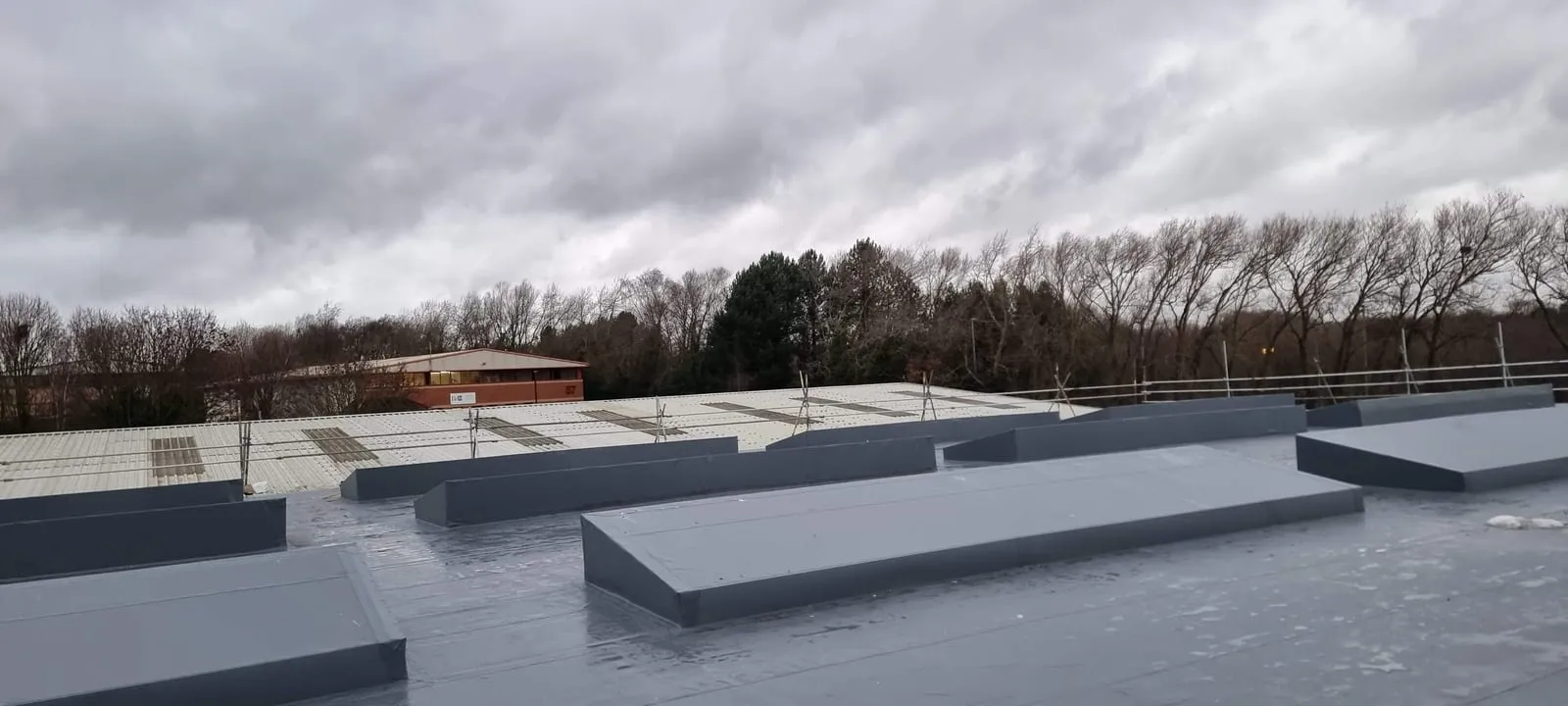
If you’re replacing a flat roof in South Yorkshire, the two quotes you’re most likely to be comparing are GRP (fibreglass) and single ply membrane. Both get sold as long-life, low-maintenance systems, and both look smart on completion day. They are not the same roof.
We should be upfront: we fit single ply and we don’t fit GRP. So this guide sets out how the two actually compare, where GRP has genuine strengths, and when it can be a reasonable choice, so you can judge any quote you’re given, including ours.
The short answer
For most homes, and nearly every roof with rooflights, upstands or living space underneath, single ply is the better long-term roof. It’s a flexible membrane, heat-welded at every join, with a 40+ year design life and a 20-year manufacturer-backed guarantee plus our 20-year workmanship warranty, both in writing. GRP is a rigid resin shell. It can be cheaper on the quote, but on the roofs we’re called out to, it commonly cracks within 10 to 15 years, and it is harder to repair well once it does.
What each system actually is
GRP (glass reinforced plastic) is built on site. Glass-fibre matting is laid over a timber deck and soaked in liquid resin, which sets hard. A coloured topcoat is rolled on for UV protection. The result is a smooth, hard, one-piece surface.
Single ply is a factory-made waterproof membrane, usually PVC, TPO or FPO, laid in large sheets and joined by hot-air welding. The welded laps fuse into one continuous skin, with no glue or resin doing the waterproofing. It’s the same family of system used on Wembley and on the 28,000 m² Google data centre roof we worked on, scaled down to garages and back extensions. Our single ply roofing page covers the build-up and the manufacturer systems we’re trained on.
GRP vs single ply: side by side
| Single ply membrane | GRP fibreglass | |
|---|---|---|
| Lifespan | 40+ year design life | Cracking at 10–15 years is common on the roofs we strip out |
| Movement and cracking | Flexes with the building | Rigid; cracks at upstands, deck joints and edges |
| Weather needed to install | Fitted most of the year; laps must be dry to weld, but there’s no cure time | Needs a dry deck and dry, mild weather for the resin to cure |
| Repairability | A patch of the same membrane is welded in and fuses to the roof | New resin bonds poorly to old, weathered GRP |
| Typical price per m² | £100–£118/m² supplied and fitted (from £90/m² on larger roofs); about +£40/m² for warm-roof insulation | We don’t fit GRP, so we don’t publish a rate; compare quotes on the same build-up |
| Warranty | 20-year manufacturer-backed guarantee + 20-year workmanship warranty, both in writing | Varies by product and installer; often the installer’s promise only |
Where GRP has genuine strengths
It would be dishonest to pretend GRP has nothing going for it.
- A hard, walkable surface. GRP takes foot traffic without needing a separate walkway layer.
- No visible seams. It’s laid as one continuous coat, which some people prefer the look of.
- It can be cheaper on the quote. Sometimes noticeably so, particularly on a small roof.
- Easy to get hold of. Kits are sold over the counter at builders’ merchants, which is why so many roofers offer it.
That last point is also its biggest weakness, as we explain in why GRP is the cowboy roofer’s favourite product.
Where GRP falls down
It’s rigid, and buildings move. Timber decks expand and contract with the seasons, extensions settle, and doors and bi-folds flex at the upstands. A rigid resin shell can’t follow that movement, so it cracks where the stress collects: corners, upstands, deck joints and edges. Water then gets in between the GRP and the deck and rots the timber.
The resin has to cure in the right conditions. GRP needs a dry deck and dry, mild weather. South Yorkshire doesn’t hand out many of those days in autumn and winter, and a building programme or a leaking roof often can’t wait. Resin laid in damp or cold conditions may never cure properly.
Repairs are hard to get right. New resin doesn’t bond reliably to old, UV-weathered GRP, so patches on an ageing roof tend to fail at their edges. More on this in why we don’t recommend GRP fibreglass flat roofs.
Single ply’s honest downsides
Single ply isn’t perfect either.
- It usually costs more up front than a basic GRP or felt quote.
- It needs a trained installer. Manufacturers only guarantee roofs fitted by contractors they’ve trained, which is good for quality but leaves you fewer roofers to choose from.
- Seams are only as good as the welding. A badly welded lap or a rushed upstand detail will leak, whatever the membrane.
- Regular foot traffic needs protection. For a balcony or a roof you walk on often, we add a walkway layer or a paving build-up on top.
When GRP can be acceptable
We still wouldn’t fit it, but GRP can be a reasonable roof when all of these are true:
- the roof is small and simple, with few upstands and no rooflights or lanterns;
- the deck is sound, dry and well supported, so there’s little movement;
- the installer is trained on the specific GRP system and uses that manufacturer’s complete kit, not a mix of merchant products;
- it’s laid in dry, mild weather, with the time allowed for it to cure properly.
If your existing GRP roof is young and sound, with one localised problem, a repair by a GRP specialist may be all you need. We’ll tell you honestly if that’s the case rather than sell you a new roof. If the roof is cracking in several places, patching is usually money spent on a roof that will fail somewhere else next winter.
Installation matters more than the label
Whichever system you choose, most flat roof failures come down to the fitting, not the material. Before you compare two totals, ask each contractor:
- Which exact product and system are you specifying? “Fibreglass” or “single ply” on its own isn’t enough.
- Who trained you on it? Ask for the manufacturer’s name.
- Who issues the warranty? A manufacturer-backed guarantee is different from a fitter’s promise.
- How are the deck, insulation, outlets and upstands being dealt with? Those details cause more leaks than the open middle of the roof.
- Can I see one of your roofs that’s five or more years old?
Insulation belongs in the same conversation. On a replacement over a heated room, Building Regulations usually mean upgrading the insulation to a U-value of 0.18 W/m²K, so make sure both quotes include the same warm-roof build-up before comparing prices.
What it costs
Most homes pay £100–£118/m² inc VAT for single ply, supplied and fitted (from £90/m² on larger roofs), with around +£40/m² for a warm-roof insulation upgrade. A single garage of about 20 m² comes to £2,000–£2,360 and a double of about 30 m² to £3,000–£3,540. Most rear extension roofs land between £2,800 and £5,500, while a 40 m² warm-roof extension comes to around £5,600–£6,320. Repairs run from £250 to £1,500. The full breakdown is on our pricing page.
On an extension with a lantern or rooflights, the gap between the two systems is at its widest, because every opening adds corners where rigid GRP cracks. Our guide to single ply on rear extensions with skylights goes through those details.
Quick answers
Is GRP cheaper than single ply? Sometimes on the quote, rarely over the life of the roof. A GRP roof that cracks at year 12 has to be stripped and replaced, so you pay for the roof twice.
Can single ply go over an existing GRP roof? Usually we strip the GRP off first. By the time GRP has cracked, water has often reached the deck, and we need to see and replace any soft timber.
Do you cover my area? Yes, across South Yorkshire, including Rotherham, Sheffield, Doncaster and Barnsley. If you’re in Rotherham, our GRP vs single ply in Rotherham post looks at the local picture.
Get an honest second opinion
If you’ve been quoted GRP and want a like-for-like single ply price, use the estimator for a range in about 60 seconds, or book a free quote visit and we’ll look at the roof properly. If a repair is the better answer for your roof, that’s what we’ll tell you.
Need a flat roof estimate?
60 seconds, no callback chasing. Just an honest price range.
Get my price