Single Ply Roofing for Rear Extensions with Skylights
Why single ply is the right roof for a rear extension with skylights or a roof lantern: 40+ year lifespan, welded watertight details, and why it beats GRP.
If you’re building a rear extension with skylights or a roof lantern, the membrane around that glass matters more than the glass itself. A lantern only leaks in one place: where the roof covering meets the upstand it sits on. Get that detail right and the roof is watertight for decades. Get it wrong and you’ll be chasing drips down your new plasterwork within a few winters.
Here’s the short version: single ply membrane is the best covering for an extension roof with rooflights — it’s heat-welded around every opening with no glue and no wet resin, it flexes with the building instead of cracking, and it carries a 20-year manufacturer-backed warranty with a 40+ year service life. GRP fibreglass, the usual alternative quote you’ll get, is a rigid resin shell that concentrates stress at exactly the corners a lantern creates — and on the roofs we strip out, it typically fails within 10–15 years.
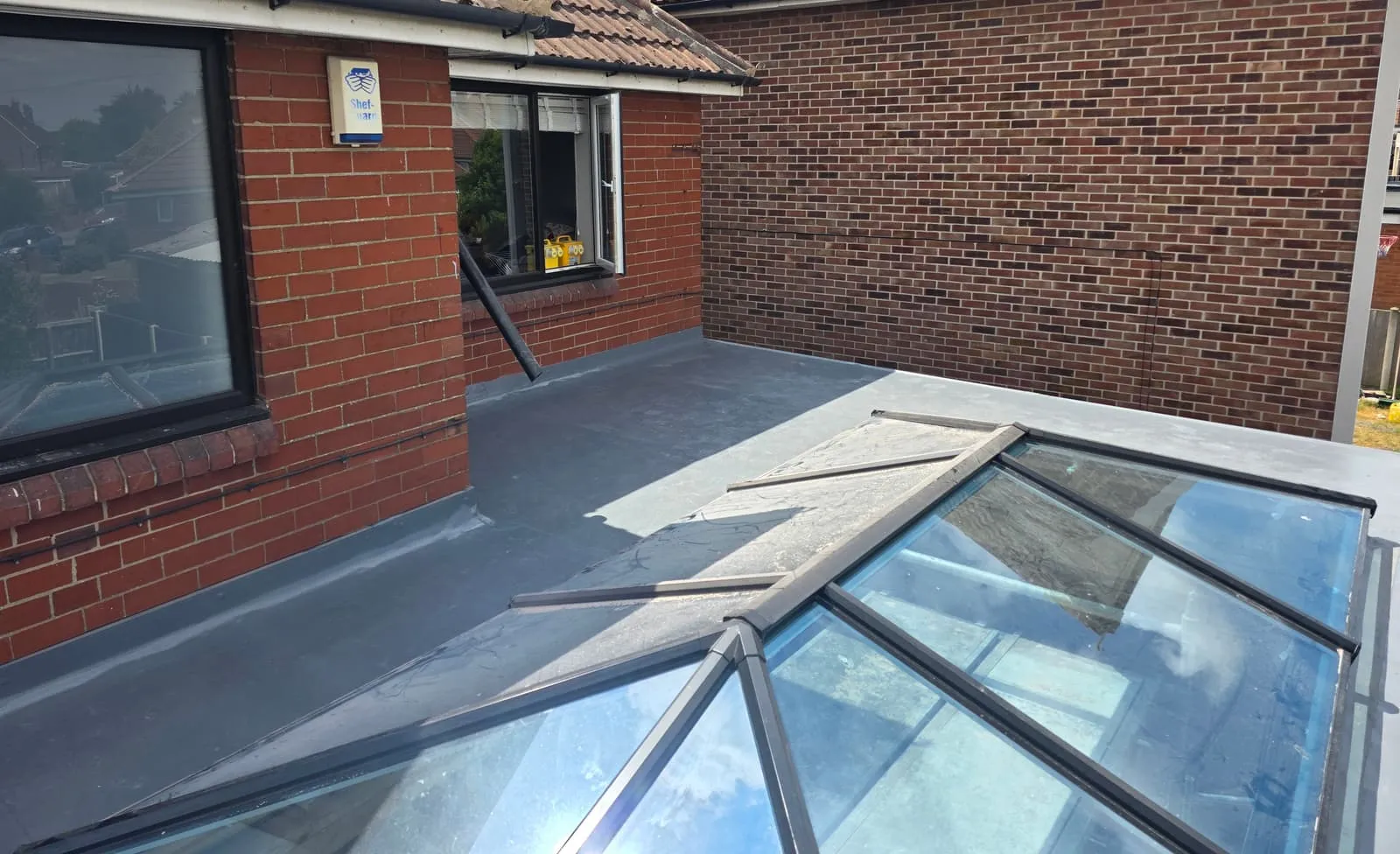
The photo above is one of ours: a rear extension we finished in summer 2025, grey PVC single ply welded around a four-panel glass lantern. This guide explains what we did there and why it works, so you can judge any quote you’re given — including ours.
Why an extension roof with skylights is a harder roof
A plain flat roof is one big rectangle of membrane and four edges. Add a roof lantern and two flat rooflights and you’ve added twelve corners, three upstands and three perimeter terminations — every one a place where water will find a shortcut if the detailing is casual.
Extension roofs raise the stakes further:
- There’s living space directly underneath. A leaking garage roof ruins some paint tins. A leaking kitchen-diner roof ruins a ceiling, a floor and your patience.
- Kitchens make moisture. Cooking, kettles and dishwashers push warm, wet air up at the roof. Without the right build-up, that moisture condenses inside the roof — which looks exactly like a leak and rots the deck just as fast.
- Big glazing changes the temperatures. The roof areas between rooflights get hot in sun and cold at night. The covering has to expand and contract with that cycling, every day, for decades.
So the question isn’t “which membrane is cheapest per square metre”. It’s “which membrane handles openings, movement and moisture best”. That’s single ply, and here’s why.
How single ply is detailed around a skylight or lantern
A roof lantern or rooflight sits on a timber kerb — an upstand — built up from the roof deck. On our installs that upstand is a minimum of 150 mm above the finished roof surface, the height British Standard guidance (BS 6229) recommends so that heavy rain and sitting snow can’t reach the top of the waterproofing.
The membrane is then:
- Welded up and over the upstand with hot air, fusing the sheets into one continuous piece — no glue, no sealant bead doing the real work.
- Finished with factory-made corner details at each of the lantern’s corners, welded in rather than folded and hoped for.
- Terminated under the lantern’s own kerb section, so the glazing unit sheds water onto the membrane, which sheds it to the outlet.
The result is one welded skin from the gutter to the glass. There’s no joint that depends on adhesive, mastic or a resin cure — the failure points that finish off most extension roofs — and the same is true at the house wall, the fascia edges and the outlets.
It’s the same detailing discipline we use on commercial roofs with hundreds of rooflights — the Be Modern factory in Jarrow got new skylights across 1,850 m² — scaled down to a back garden.
How long does a single ply extension roof last?
- Design life: 40+ years. The PVC and TPO systems we install have independently assessed durability data well beyond their warranty periods. Membranes fitted in the 1980s are still in service across Europe.
- Warranty: 20 years from the manufacturer, plus our own 20-year workmanship guarantee, both in writing. On an extension that paperwork matters: if you sell, it shows a buyer’s surveyor that the roof over the kitchen isn’t a question mark.
- What actually determines the lifespan: the spec (a proper 1.5 mm membrane, not a budget thin sheet), the detailing at upstands and edges, and drainage that doesn’t leave standing water. All three are down to the installer, which is why the workmanship guarantee should carry the same term as the membrane warranty.
Maintenance is minimal: keep the outlets clear of leaves, glance over the upstands once a year, and have it inspected if anything ever gets dropped on it. There’s no topcoat to re-apply, no chippings to rake, no resin to re-seal.
Single ply vs GRP on an extension: the honest comparison
GRP (fibreglass) is the covering most often quoted against single ply for extensions, so it deserves a straight answer. We don’t fit GRP, and extensions with skylights are the clearest example of why.
| Single ply membrane | GRP fibreglass | |
|---|---|---|
| Around skylights | Heat-welded upstand details, factory corners | Resin laid by hand into every corner |
| Building movement | Flexes with the timber structure | Rigid shell — cracks at stress points |
| Installation weather | Welded in most conditions, year-round | Resin needs dry, mild weather to cure |
| Typical life in the field | 40+ years design life | 10–15 years before cracks appear |
| Warranty | 20-year manufacturer + 20-year workmanship | Varies; often installer-only |
| Repairs later | Weld a patch, invisible fix | Resin bonds poorly to weathered GRP |
Two of those rows matter most for a lantern roof:
Corners. GRP is rigid. Timber extensions move — the deck expands, the bi-fold opening below flexes, the whole structure settles. All that movement concentrates at sharp changes of direction, and a lantern kerb is four of them in a row. That’s why the cracks in a failed GRP roof are almost always at the upstands and corners, not out in the open field of the roof.
Weather during the build. GRP resin has to be laid on a dry deck in dry, mild conditions and left to cure. South Yorkshire doesn’t hand out many of those days, and an extension build programme can’t wait for them. Single ply is mechanically fixed and hot-air welded — we install it right through the seasons, and the weld is tested the same day, not left to cure overnight under a tarpaulin.
Felt sits somewhere in between — cheaper upfront, torch-applied laps rather than welded seams, and a 10–15 year realistic life before the blisters start. On a roof you’ll be looking down on from the bedroom window, it also ages the worst of the three.
Get the build-up right: warm roof, VCL, then the membrane
Because an extension is heated living space, building regulations require the roof to be insulated — and the right way to do it under single ply is a warm roof: vapour control layer on the deck, rigid insulation above it, membrane on top.
On an extension with a lantern this isn’t just a box-ticking exercise:
- The vapour control layer stops kitchen moisture getting into the insulation and condensing — the invisible failure that writes off flat roofs from the inside.
- Insulation above the deck keeps the timbers warm and dry, so the structure holding your glass lantern up isn’t cycling through damp and dry every season.
- It cuts heat loss from what is usually the most-glazed, most-used room in the house. Adding warm roof insulation costs about +£40/m² on top of the membrane — on a living space it’s nearly always worth it. More on warm roof upgrades here.
What a single ply extension roof costs
Briefly — we’ve published a full single ply cost guide and a price list with the detail. Single ply is £100–£118/m² inc VAT supplied and fitted on most homes (from £90/m² on larger roofs). Most rear extension roofs land between £2,800 and £5,500 depending on size, access and spec; a 40 m² extension with warm-roof insulation is £5,600–£6,320. Detailing around each rooflight adds labour rather than a big materials bill, and it’s included in our quote — not an extra on the invoice.
For a number on your own roof, the 60-second estimator will give you a range without a phone call, and the written quote, including our visit to measure up, is free.
Extension skylight roofing FAQs
Can you fit skylights or a lantern into an existing flat roof? Usually, yes — if the structure can take the opening and the existing covering is sound enough to tie into. Often the smart move is to do both at once: new openings and a new membrane, one warranty covering the lot. We’ll tell you honestly which camp your roof is in at the free quote visit.
Do roof lanterns leak? Quality lanterns rarely leak through the glazing. When a lantern roof leaks, it’s almost always the waterproofing detail at the kerb — which is an installer problem, not a lantern problem. It’s also why we’d rather you judge roofers by their upstand details than by their day rate.
Is GRP cheaper than single ply for an extension? Sometimes on the quote, rarely over the life of the roof. A GRP roof that cracks in year 12 has to be stripped and replaced — you pay for the roof twice, plus the ceiling repairs. Single ply is fitted once, with a 20-year warranty backing it.
How high should the upstand be around a skylight? British Standard guidance recommends at least 150 mm from the finished roof surface to the top of the waterproofing. If a quote shows a lantern sat on a low kerb barely proud of the roof, that roof has a leak on order.
What colour does the membrane come in? Most of our extension roofs are fitted in light or dark grey, which looks sharp against brick and glazing and reflects less heat into the rooms below than black felt. Other colours are available on request.
Which areas do you cover? All of South Yorkshire — Rotherham, Sheffield, Doncaster and Barnsley — plus commercial work nationally.
Planning an extension? Send us your architect’s drawing and we’ll price the roof from it — or get an instant range with the estimator. Free quote visit, fixed written price, and the same person who prices the roof stands behind the 20-year workmanship guarantee.
Need a flat roof estimate?
60 seconds, no callback chasing. Just an honest price range.
Get my price